


As a custom club fitter, grip size is one of the most overlooked variables in the entire bag. Shaft flex and clubhead design get all the attention, but the grip is the only part of the club that actually touches you. Get it wrong, and it can quietly sabotage everything else you're working on.
Let's break down exactly how grip size influences your swing, how to figure out what size is right for you, and how to measure your hand the correct way.
Does Grip Size Affects the Swing?
Grip size changes how freely your hands and wrists can rotate through the swing. That single fact has a ripple effect on face angle at impact, clubhead speed, and shot shape.
Grip Size and Left/Right Tendencies
This is the big one, and it's the reason I check grip size before almost anything else when someone comes to me with a directional miss.
- Grips that are too small encourage the hands to become overactive. With less material to hold onto, golfers tend to grip tighter and their hands naturally want to "do more" through impact. This often leads to excessive forearm rotation and a closed clubface at impact — resulting in a hook or pull for many players.
- Grips that are too large restrict natural hand rotation. The hands can't release the club as freely through the hitting zone, which tends to leave the face open at impact — leading to a push or slice.
I want to be clear: grip size is rarely the only cause of a hook or slice, but it's frequently a contributing factor, and it's one of the easiest to fix. I've had players "fix" a two-year slice with a grip size adjustment and a bucket of range balls.
Grip Size and Clubhead Rotation
Your hands and wrists are the last link in the kinetic chain before the clubhead. Grip size directly affects how much the clubface can rotate (open to closed) during the swing.
- Smaller grips = more rotation available = more clubhead "release"
- Larger grips = less rotation available = a more stable, quieter clubface
This is why you'll sometimes see fitters intentionally build up the grips of a player who has too much hand action in their swing — it's a simple way to calm down an overactive release without asking the golfer to make a swing change.
Grip Size and Clubhead Speed
There's a common myth that smaller grips always mean more speed. It's true that a smaller grip can allow for more wrist hinge and a faster release, which can add ball speed for some players. But that's only half the story.
If a grip is too small for your hands, you'll often grip it tighter to maintain control — and tension in the hands and forearms is one of the fastest ways to lose clubhead speed. A grip that fits properly lets you hold the club with light, secure pressure, which promotes better wrist hinge, a freer release, and ultimately more speed than a poorly sized grip that forces you to squeeze.
In short: the fastest grip size isn't the smallest one — it's the one that lets you hold on with the least tension.
What Size Golf Grip Should I Use?
Choosing the right golf grip comes down to three factors: hand size, comfort/feel, and your natural swing tendencies.
1. Selecting Grip Size Based on Hand Size
Hand size (specifically glove size) is the starting point for almost every fitting. Here's the general chart I use as a baseline:
| Glove Size | Hand Length (Fingertip to Wrist Crease) | Recommended Grip Size |
|---|---|---|
| Small (or smaller) | Less than 7" | Undersize |
| Medium | 7" – 7¾" | Standard |
| Medium/Large | 7¾" – 8¼" | Standard or Midsize |
| Large | 8¼" – 8¾" | Midsize |
| X-Large | 8¾" and up | Midsize or Oversize |
A quick note on grip thickness for reference — most standard grips measure around 0.900" in diameter at the smallest section (butt end sizing may vary by manufacturer). Common categories from there:
- Undersize: roughly 1/64" to 1/32" smaller in circumference than standard
- Standard: the baseline size most clubs ship with from the factory
- Midsize: roughly 1/16" larger in circumference than standard
- Oversize/Jumbo: 1/8" or more larger in circumference than standard
Most grip manufacturers like Golf Pride, SuperStroke, or Iomic offer at least these 4 sizes. Keep in mind grips can also be custom-built with extra wraps of tape to land anywhere between these categories — this is something for players who fall between sizes.
2. Comfort Level
Charts are a great starting point, but they're not gospel. Comfort matters, and I always let a player's hands cast the deciding vote. Some things I look for during a fitting:
- Do your fingers dig into your palm? That's usually a sign the grip is too small.
- Do you feel like you can't close your hand fully around the grip, or does your palm feel disconnected from your fingers? That often means it's too large.
- Does your grip pressure change during the swing? If a golfer starts light and squeezes hard by the top of the backswing, the grip is often too small for their comfort.
If a player tells me a grip "feels great" but it's technically outside their measured range, I don't force the chart on them. Feel and function need to agree.
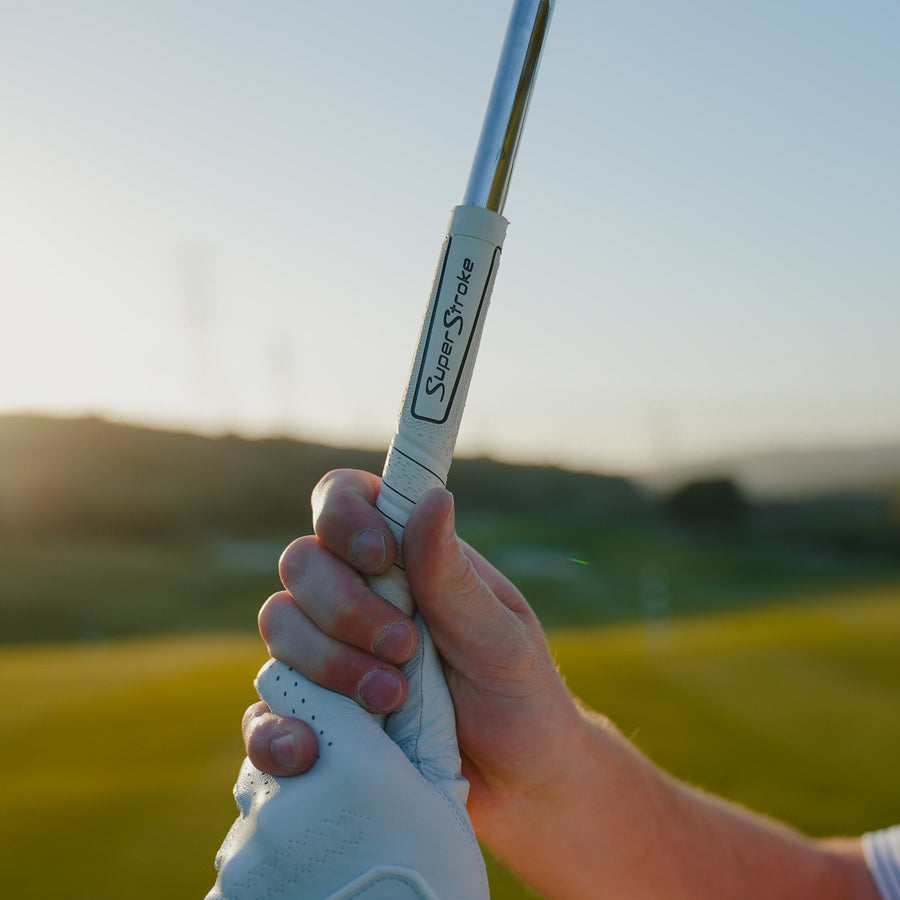
3. Swing Tendencies
This is where fitting becomes as much art as science. I'll often deviate from the "correct" measured size based on what a player's ball flight is telling me:
- Chronic hook or draw-biased players who otherwise measure into a standard size often benefit from sizing up slightly to quiet down hand rotation.
- Chronic slice or fade-biased players who measure into a standard size sometimes benefit from sizing down slightly to encourage a fuller release.
- Players with hand or wrist conditions (arthritis, tendonitis, previous injury) often do better with a slightly larger grip and lighter grip pressure, regardless of hand size, to reduce strain and grip tension.
This is exactly why a proper fitting includes hitting balls with different grip sizes, not just measuring your hand and calling it done.
How to Measure Your Hand for Golf Grip Size
You can get a solid starting estimate at home in about two minutes. Here's how I do it during a fitting:
- Measure hand length. Hold your dominant hand flat, fingers together. Measure from the crease of your wrist (where your palm meets your wrist) to the tip of your middle finger. This is your primary measurement for the chart above.
- Check your glove size. If you already wear a golf glove, that size is a strong reference point and usually aligns closely with hand length.
- Measure finger length (secondary check). Measure your middle finger from the base (where it meets the palm) to the tip. Longer fingers relative to overall hand length can sometimes push a player toward a slightly larger grip even if overall hand length suggests standard.
- Grip a club and check finger-to-palm contact. This is the step most people skip, and it's the most important one. Take your normal grip on a club. With a properly sized grip, the fingers of your top hand should just barely touch or lightly graze the pad of your palm — not dig in deeply, and not float with a gap. That contact point is the real-world confirmation of everything the tape measure told you.

A tape measure and a chart get you in the right neighborhood. But if you want the exact right size — the one that quiets your miss and doesn't cost you speed — nothing replaces hitting balls with a launch monitor while a fitter adjusts grip size in real time. It's a small piece of equipment, but in my bay, it's one of the first things I check, and one of the highest-leverage changes I can make for a golfer's ball flight.
I Use A Standard Grip Size, When Do I Know when to Move to Midsize?
This is one of the most common questions I get in the fitting bay, usually from players who've been gaming standard grips for years without ever questioning it — because that's simply what came on the club. A few signs tell me it's time to test a player in midsize:
- You have a hook or draw you can't seem to shake. If your hand measurements put you right on the border between standard and midsize, and your miss is consistently left (for a righty), sizing up is often the first thing I'll test. A slightly larger grip quiets down hand rotation and can single-handedly tighten up dispersion.
- Your hands feel like they're working overtime. If you notice your top hand's fingers digging into your palm, or you feel like your hands are "flipping" through impact, that's a tactile sign the grip is smaller than it should be for how your hands function — even if it measures as standard.
- You have any hand, wrist, or finger conditions. Arthritis, tendonitis, past injuries, or general joint stiffness are all reasons I'll move a player to midsize regardless of what the tape measure says. A larger grip reduces the need for tight grip pressure, which reduces strain.
- You have larger-than-average fingers relative to your palm. Some players measure standard on hand length but have noticeably long or thick fingers. That combination often plays better in midsize, even though the chart says standard.
- You've added grip tape buildup over the years and it's still not enough. If you're already running an extra wrap or two of tape under a standard grip just to get it comfortable, that's a clear sign your hands are asking for a true midsize grip rather than a modified standard.
- You're chasing a quieter, more stable clubface. Some players don't have a specific miss — they just want more consistency and less clubface rotation through impact. Less active hands generally means more predictable strikes, and midsize is the simplest way to get there without changing your swing.
If none of these apply and you're happy with your ball flight and comfort, there's no need to change — "standard" is standard because it works for the majority of golfers. If you're on the fence, or don't quite want to commit to a Midsize Grip, building a Standard grip with 2-3 extra wraps of tape can provide a great in-between solution.


